



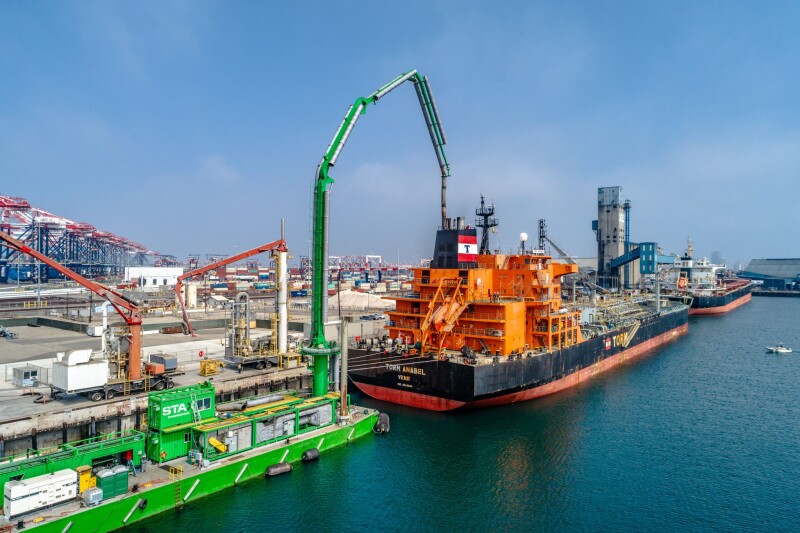
STAX Engineering, Long Beach, Calif., on Monday announced it has received an executive order from the California Air Resources Board (CARB) authorizing it to service tanker vessels, meaning its emissions capture and control fleet is now approved to serve all major vessel classes.
The order includes approval for four barges: STAX 1, STAX 5, STAX 7, and STAX 8. The company’s barge-based system provides emissions capture without requiring retrofits or costly shore-side infrastructure.
Tankers, which transport over $800 billion in goods annually, have traditionally been excluded from shore power use due to safety risks associated with their volatile cargo. CARB’s Ocean-Going Vessels At Berth Regulation took effect for tankers at the Ports of Los Angeles and Long Beach on Jan. 1, 2025, and will expand to all California ports in 2027.
Mike Walker, CEO of STAX Engineering, said, “Tankers are the backbone of global energy infrastructure — with over 1.3 million barrels of crude oil alone arriving just in California ports daily — yet they’ve lacked a safe, practical solution for meeting rising emissions standards. Our technology fills that gap. It helps operators comply with regulations while improving air quality for surrounding communities.”
STAX’s system connects directly to a vessel’s exhaust stack and captures emissions from auxiliary engines. It does not require electrical hookups or modifications to the vessel. According to the company, the system removes up to 99% of particulate matter and 95% of nitrogen oxides while adhering to tanker safety standards.
STAX reports that since early 2024, it has treated 1,192 vessels for a cumulative 25,000 hours, capturing 190 tons of pollutants. Nearly 1,000 of those hours were dedicated to tanker vessels.
The company currently operates in five California ports — Long Beach, Los Angeles, Hueneme, Benicia, and Oakland — and is the sole approved on-call provider at the Port of Los Angeles. STAX serves clients including Olympus Terminals, Shell, and MOL Chemical. It holds exclusive agreements at Olympus’s F209 berth in Long Beach and Shell’s Mormon Island Terminal in Los Angeles.
Vince Godfrey, CEO at Olympus Terminals, said, "Given the complexities of tanker operations, we need a partner who can integrate seamlessly and safely into our customers' port calls without disrupting operations. STAX provides exactly that; a practical solution without requiring retrofits that allows us to meet our environmental responsibilities immediately, rather than waiting for future technologies."
Backed by $70 million in funding, STAX plans to expand its fleet to 27 barges and establish operations at all California ports by 2027. The company is also growing internationally, having recently secured £1.1 million in U.K. government funding through the Clean Maritime Demonstration Competition for the PortZero project, a partnership with Seabound, Associated British Ports, and Lomar Shipping.
